Oracy

Spoken Language

Mastery of the spoken language enables successful discussion, inspiring speech and effective communication. In years 1 – 6, children are required to:

  • listen and respond appropriately to adults and their peers
  • ask relevant questions to extend their understanding and knowledge
  • use relevant strategies to build their vocabulary
  • articulate and justify answers, arguments and opinions
  • give well-structured descriptions, explanations and narratives for different purposes, including for expressing feelings
  • maintain attention and participate actively in collaborative conversations, staying on topic and initiating and responding to comments
  • use spoken language to develop understanding through speculating, hypothesising, imagining and exploring ideas
  • speak audibly and fluently with an increasing command of Standard English
  • participate in discussions, presentations, performances, role play, improvisations and debates
  • gain, maintain and monitor the interest of the listener(s)
  • consider and evaluate different viewpoints, attending to and building on the contributions of others
  • select and use appropriate registers for effective communication.


In order to achieve the aims of the spoken language curriculum as outlined in the national curriculum, we at St. Paul’s focus on developing 4 key areas of pupil’s oracy: the physical, the linguistic, the cognitive, and the social and emotional.


Autumn

Spring

Summer

Year 1

Physical Oracy:

Speak clearly and confidently in a range of contexts.

Linguistic Oracy:

Speak in sentences using joining phrases to link ideas.

Cognitive Oracy:

Offer reasons for their opinions

Social & Emotional Oracy:

Listen and respond appropriately to others

Physical Oracy:

Use appropriate tone of voice in the right context e.g. To project their voice to a large audience.

Linguistic Oracy:

Using vocabulary appropriately specific to the topic

Cognitive Oracy:

Recognise when they haven’t understood something and ask a question

Social & Emotional Oracy:

Be willing to change their mind based on what they have heard

Physical Oracy:

Continue to use gesture to support delivery e.g. pointing at parts of a plant they are discussing.

Linguistic Oracy:

Take opportunities to try out new language, even if it is not always correctly used.

Use sentence stems to link to other’s ideas in group discussion

Cognitive Oracy:

Disagree with someone else’s opinion politely

Explain ideas and events in chronological order

Social & Emotional Oracy:

Begin to organise group discussions independently of an adult

Year 2

Physical Oracy:

Speak clearly and confidently with appropriate volume and pace in a range of contexts.

Linguistic Oracy:

Speaking in sentences using joining phrases to create longer sentences. Through encouragement to use conjunctions and sentence stems in speech and writing.

Cognitive Oracy:

Ask questions to find out more about a subject

Social & Emotional Oracy:

Start to develop an awareness of audience e.g. what might interest a certain group

Physical Oracy:

Gestures start to become increasingly natural to support speech e.g. gesturing towards someone if referencing their idea.

Linguistic Oracy:

Adapt how to speak in different situations according to the audience.

Cognitive Oracy:

Build on others’ ideas in discussions

Social & Emotional Oracy:

Start to show awareness of others who have not spoken and invite them into the discussion e.g. saying their name, asking them a question, turning to them

Physical Oracy:

Use body language to show active listening and support meaning when speaking e.g. nodding along, facial expressions.

Linguistic Oracy:

Use sentence stems to signal when they are building or challenging others’ ideas in groups.

Cognitive Oracy:

Make connections between what has been said and their own and others’ experiences

Social & Emotional Oracy:

Recite/deliver short preprepared material to an audience

Performance

In the Autumn term of Year 2, children will prepare and perform a production of the Nativity to the whole school.

Year 3

Physical Oracy:

Deliberately selects gestures that support the delivery of ideas e.g. gesturing towards someone if referencing their ideas.

Linguistic Oracy:

Be able to use specialist language to describe their own and others’ talk.

Cognitive Oracy:

Offer opinions that aren’t their own e.g. taking on the role of …

Social & Emotional Oracy:

Speak with confidence in front of an audience.

Physical Oracy:

Deliberately varies tone of voice in order to convey meaning e.g. speaking authoritatively during an expert talk.

Linguistic Oracy:

Use specialist vocabulary e.g. speak like an archaeologist.

Cognitive Oracy:

Begin to reflect on discussions and their own oracy skills and identify areas of strength and areas to improve.

Social & Emotional Oracy:

Begin to recognise different roles within group talk e.g. chairperson

Physical Oracy:

Consider position and posture when addressing an audience.

Linguistic Oracy:

Make precise language choices e.g. instead of describing a cake as ‘nice’ using ‘delectable’.

Cognitive Oracy:

Reach shared agreement in discussions

Social & Emotional Oracy:

Adapt the content of their speech for a specific audience

Year 4

Physical Oracy:

Deliberately select movement and gesture when addressing an audience.

Linguistic Oracy:

NA

Cognitive Oracy:

Give supporting evidence e.g. citing a text (using sentence stems) a previous example or a historical event

Social & Emotional Oracy:

Use more natural and subtle prompts for turn taking

Physical Oracy:

To use pauses for effect in presentational talk e.g. when telling an anecdote or joke.

Linguistic Oracy:

Carefully consider the words and phrasing they use to express their ideas and how this supports the purpose of the talk e.g. to persuade or to entertain

Cognitive Oracy:

Ask probing questions

Social & Emotional Oracy:

Start to develop empathy with an audience

Physical Oracy:

Use the appropriate tone of voice in the right context.

Linguistic Oracy:

NA

Cognitive Oracy:

Reflect on their own oracy skills and identify areas of strength and areas to improve and begin to set own targets

Social & Emotional Oracy:

Consider the impact of their words on others when giving feedback

Performance

In the Spring term of Year 4, children will prepare and perform a production of the Easter Story to the whole school.

Year 5

Physical Oracy:

Deliberately varies tone of voice in order to convey meaning e.g. speaking authoritatively during an expert talk, or speaking with pathos when telling a sad part of a story.

Linguistic Oracy:

Use an increasingly sophisticated range of sentence stems with fluency and accuracy to cite evidence and ask probing questions.

Cognitive Oracy:

Draw upon knowledge of the world to support their own point of view and explore different perspectives

Social & Emotional Oracy:

Listen for extended periods of time including notetaking, drawing visual

Physical Oracy:

Project their voice to a large audience.

Linguistic Oracy:

Consider the words and phrases used to express their ideas and how this supports the purpose of talk.

Cognitive Oracy:

To be able to give supporting evidence e.g. citing a text, a previous example or a historical event

Social & Emotional Oracy:

Adapt the content of their speech for a specific audience e.g. use of humour

Physical Oracy:

Gestures become increasingly natural

Linguistic Oracy:

NA

Cognitive Oracy:

Identify when a discussion is going off topic and be able to bring it back on track with support and use of sentence stems e.g. That might be true, however what do you think about …?

Social & Emotional Oracy:

Speak with flair and passion

Year 6

Physical Oracy:

Speak fluently in front of an audience.

Linguistic Oracy:

Use and innovate an increasingly sophisticated range of sentence stems with fluency and accuracy.

Cognitive Oracy:

Construct a detailed argument or complex narrative

Social & Emotional Oracy:

Use humour effectively

Physical Oracy:

Consciously adapt, tone, pace and volume of voice.

Linguistic Oracy:

Vary sentence structures and length for effect when speaking.

Cognitive Oracy:

Spontaneously respond to and offer increasingly complex questions, citing evidence where appropriate

Social & Emotional Oracy:

NA

Physical Oracy:

Have a stage presence.

Linguistic Oracy:

Be comfortable using idioms and expressions.

Cognitive Oracy:

Reflect on their own and others’ oracy skills and identify how to improve.

Social & Emotional Oracy:

Begin to be able to read a room or a group and take action accordingly e.g. if everyone looks disengaged, moving on or changing topic, or if people look confused stopping to take questions

Performance

In the Summer term of Year 6, children will prepare and perform a Leavers’ production to the whole school.

Writing


Here at St Paul’s, children are provided with rich and varied opportunities for writing and write for a range of audience and purposes around a wide range of topics. All year groups have mapped out writing units to ensure that teaching and learning not only meets the requirements of the National Curriculum but also builds upon cross-curricular knowledge.

As part of our English curriculum here at St Paul’s, writing is the product of a sequence of lessons designed to model and scaffold ‘what a good one looks like’ and acknowledge that effective writing is an amalgamation of various skills, ranging from the technical to the creative.

The build up to writing is supported through:

pencil

  • Identifying and truly understanding the audience and purpose of a text– this is done by analysing existing texts to study how the writer has met the audience and purpose. We unpick the tone, formality and key features of the text and hook the pupils into the writing unit in this way.
  • Grammar, punctuation and spelling – practising the grammatical elements of writing. This is mapped out progressively to ensure robust coverage of the curriculum. Pupils have the opportunity to recap existing or to be taught new skills which they apply and practise within a variety of bespoke tasks before the drafting commences.
  • Vocabulary understanding – throughout each unit we explore the use of language in the desired writing style and make choices around the use of vocabulary to create an impact on our readers.
  • Planning for writing – Planning may look different for different writing tasks however time is always taken to allow children to devise sequenced, logical and appropriate content for their writing
  • Handwriting –The importance of presentation is promoted in each lesson. The progression of handwriting is planned in progression across school.
  • Editing and redrafting – Children are taught to appreciate that writing should be continually revisited and revised to ensure it is grammatically sound as well as effective in fulfilling its purpose. We practise and develop the skills of editing within many of our sequences of work and allow time for pupils to edit independently as well as with peers.

Progression within writing

Children are encouraged to view writing as a journey and take ownership of their work. The expectation of what children should be including within their writing to meet or exceed age-related expectations forms the basis of all writing teaching and learning. Our teaching sequences are planned to introduce the pupils to the writing unit with an ‘Audience and Purpose’ focus (known as ‘Who is the reader?’ and ‘Why are we writing?’ in KS1). From this starting point, pupils unpick the main features of the writing which then leads into recapping or developing new writing skills over a series of days to allow pupils to explore their use of vocabulary, spelling and grammar to achieve the desired outcome. Drafting and editing is incorporated explicitly in KS2 although different outcomes can call for different sequences of learning.Below are examples of planning/teaching sequences that are used across school:


KS1

KS1 will continue to develop pupils’ fluency in their transcription skills through regular handwriting, spelling and dictation practice. Teachers will ensure that the curriculum for phonics has been taught and that pupils are able to apply what they have learnt in their writing. There will be a heavy focus on transcription in Year 1 and for those pupils who may require more transcription practise in Year 2 Autumn 1. This will embed and refine the basic skills of writing before pupils move on to the full writing curriculum. Lessons will include focus on correct seating/positioning, pencil grip, letter formation, transcription of dictated sentences at each groups’ phonic level matched to a weekly Little Wandle book.

writing


Each time children revisit a text type, they build upon their prior learning by being encouraged to include more ambitious vocabulary and incorporate the expectations of their year group/ the text type more consistently and with greater effect. Children are also supported to build upon their exiting knowledge and skills in writing by exploring model texts (WAGOLLs) which increase in complexity each time a text type is revisited.


English-2
English-3
writing-2
writing-1
writing-3

Early Reading

Phonics

At St Paul’s, we use the Little Wandle: Letters and Sounds Revised scheme as our platform to teach early reading. The scheme, taught from Reception to Year 1, is used to teach children that sounds are represented by letters and that these sounds can be blended together to form words. We work closely with the Westgarth English Hub to enable our Early Reading Lead and phonics practitioners to be the very best that they can be. We invest in their success to give our pupils a robust foundation in reading skills which will serve them in becoming well-rounded learners.

Little-Wandle

Foundations for phonics in Nursery

  • We provide a balance of child-led and adult-led experiences for all children that meet the curriculum expectations for ‘Communication and language’ and ‘Literacy’. These include:
    • sharing high-quality stories and poems
    • learning a range of nursery rhymes and action rhymes
    • activities that develop focused listening and attention, including oral blending
    • attention to high-quality language.
  • We ensure Nursery children are well prepared to begin learning grapheme-phoneme correspondences (GPCs) and blending in Reception by supporting children to become confident with the skills of phase 1 phonics. These skills are broken down into seven different aspects:
  • Aspect 1 – Environmental Sound Discrimination
  • Aspect 2 – Instrumental Sound Discrimination
  • Aspect 3 – Body Percussion Sound Discrimination
  • Aspect 4 – Rhythm and Rhyme
  • Aspect 5 – Alliteration
  • Aspect 6 – Voice Sounds
  • Aspect 7 – Oral Blending and Segmenting

The purpose of these different aspects is to develop children’s language abilities in the following ways:

  • Learning to listen attentively
  • Enlarging their vocabulary
  • Speaking confidently to adults and other children
  • Discriminating between different phonemes
  • Reproducing audibly the phonemes they hear

Daily phonics lessons in Reception and Year 1

  • We teach phonics for 30 minutes a day. In Reception, we build from 10-minute lessons, with additional daily oral blending games, to the full-length lesson as quickly as possible. Each Friday, we review the week’s teaching to help children become fluent readers.
  • Children make a strong start in Reception: teaching begins in Week 2 of the Autumn term.
  • We follow the Little Wandle Letters and Sounds Revised expectations of progress:
    • Children in Reception are taught to read and spell words using Phase 2 and 3 GPCs, and words with adjacent consonants (Phase 4) with fluency and accuracy.
    • Children in Year 1 review Phase 3 and 4 and are taught to read and spell words using Phase 5 GPCs with fluency and accuracy.

Daily Keep-up lessons ensure every child learns to read

  • Any child who needs additional practice has daily Keep-up support, taught by a fully trained adult. Keep-up lessons match the structure of class teaching, and use the same procedures, resources and mantras, but in smaller steps with more repetition, so that every child secures their learning.
  • We timetable daily phonics lessons for any child in Year 2 or 3 who is not fully fluent at reading or has not passed the Phonics Screening Check. These children urgently need to catch up, so the gap between themselves and their peers does not widen. We use the Little Wandle Letters and Sounds Revised assessments to identify the gaps in their phonic knowledge and teach to these using the Keep-up resources – at pace.
  • If any child in Year 3 to 6 has gaps in their phonic knowledge when reading or writing, we plan phonics ‘catch-up’ lessons to address specific reading/writing gaps. These short, sharp lessons last 10 minutes and take place at least three times a week.

Teaching reading: Reading practice sessions three times a week

  • We teach children to read through reading practice sessions three times a week. These:
    • are taught by a fully trained adult to small groups of children
    • use books matched to the children’s secure phonic knowledge using the Little Wandle Letters and Sounds Revised assessments. These books have been produced by Harper Collins and are explicitly matched to the Little Wandle scheme. For a comprehensive list of these books and which sound(s) they are matched to, please see the school website.
    • are monitored by the class teacher, who rotates and works with each group on a regular basis.
  • Each reading practice session has a clear focus, so that the demands of the session do not overload the children’s working memory. The reading practice sessions have been designed to focus on three key reading skills:
    • decoding
    • prosody: teaching children to read with understanding and expression
    • comprehension: teaching children to understand the text.
  • In Reception these sessions start in Week 4. Children who are not yet decoding have daily additional blending practice in small groups, so that they quickly learn to blend and can begin to read books.
  • In Year 2 and 3, we continue to teach reading in this way for any children who still need to practise reading with decodable books.


Additional reading support for vulnerable children

  • Children in Reception and Year 1 who are receiving additional phonics Keep-up sessions read their reading practice book to an adult one-to-one twice per week.

Ensuring consistency and pace of progress

  • Every teacher in our school has been trained to teach reading, so we have the same expectations of progress. We all use the same language, routines and resources to teach children to read so that we lower children’s cognitive load.
  • Weekly content grids map each element of new learning to each day, week and term for the duration of the programme.
  • Lesson templates, Prompt cards and How to videos ensure teachers all have a consistent approach and structure for each lesson.


For more information about phonics at St Paul’s, please see our Phonics and Early Reading policy.

Reading

In order to read for understanding and enjoyment, it is essential for children to become accurate and efficient readers, for whom decoding is an automatic process, so they can free up their attention to focus on the meaning of what they read.

Reading fluency has a qualitative definition, referring to the quality of children’s reading. This includes the use of rhythm, phrasing, intonation, ‘naturalness’, and use of voice (for different characters or moods). Reading fluency also has a quantitative definition, referring to the accuracy (number of errors, compared to number of correct words read) and the rate (number of words read per minute). The development of fluency starts as soon as children begin to blend sounds to read words in reception.

When our pupils have completed the phonics scheme and passed the phonics screen they progress on to banded books., Our follow-on reading scheme is Big Cat Collins which continues to support reading progress in fluency and understanding. All pupils undertake a reading miscue to determine their accurate level of fluency and are then regularly assessed as they make their way through the programme (at least at the start of every half term).

reading-1

Comprehension

At St Paul’s, we develop children’s reading comprehension by focusing on these key areas of understanding:

Vocabulary

Prediction

Sequence

Inference

Explanation

Summarise

These skills are explicitly taught in a progressive way to ensure that children are able to make sense of unfamiliar texts and are able to read across the curriculum with ease and enjoyment. 

Supported by evidence from the (EEF) our approach to guided reading lessons is underpinned by the development of fluency, stamina, vocabulary acquisition and the explicit teaching/modelling/thinking aloud of the core comprehension skills.  Fluency is supported through guided oral reading instruction and repeated reading during these sessions. Whole-class Guided Reading is implemented when pupils have completed the phonics programme. Teachers have a clear understanding of pupils; current capabilities and teach accordingly.

Although the key focus within EYFS and Year 1 is children developing their phonics skills, children will still be encouraged to comment on the content of what they are reading (if appropriate) through teacher-led discussion and questioning.

Reading-2

Home Reading

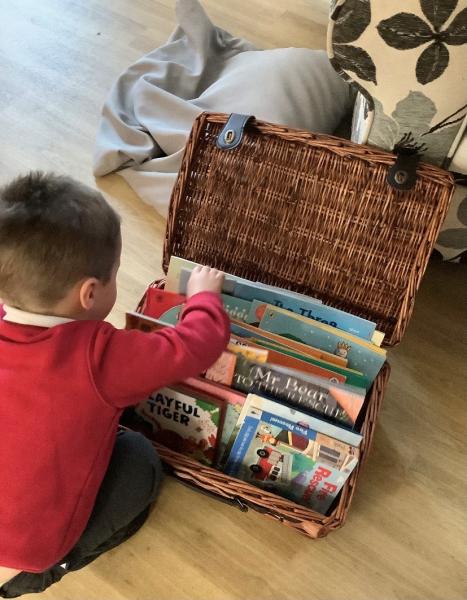
Children will begin to have reading books sent home from the summer term of nursery. These will be wordless books and are designed to promote discussion between adult and child in order to support language development and get children into positive reading habits.

From Reception until the end of Year 1, children will be sent home with two reading books each week. The first of which will be a Harper Collins Big Cat book. This book will be explicitly matched to the GPCs that children have learnt that week in school. This book will not be unfamiliar to the child as they will have read it as part of their thrice weekly reading sessions in school. By the time children read this book with an adult at home, they will be able to read it with around 93% fluency.

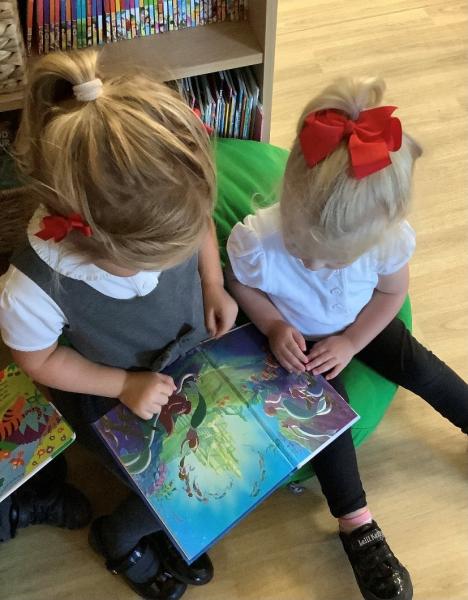
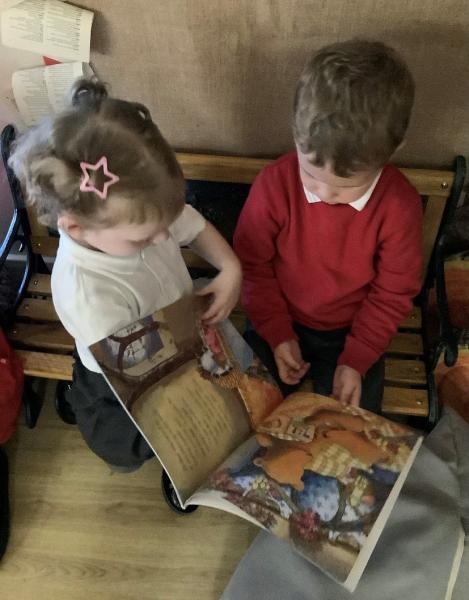
Alongside a weekly phonics book, children in Reception and Year 1 will also bring home a ‘sharing book’. This will be a text that is beyond the decoding ability of the child, however it is a book they have independently chosen in line with their interests. This gives the children an opportunity to explore books, promote choice, and begin to develop a love of reading. There is no expectation that children attempt to read any of their sharing book independently, instead it is encouraged that an adult at home will read to the child.

Once children have passed their Phonics Screening Check at the end of Year 1, they will have demonstrated that they are now able to independently decode unfamiliar texts with increasing fluency. When children enter KS2, they will begin to access Big Cat Collins book banded books. They will take home a book from the programme as well as a ‘reading for pleasure’ book from the library. This book maybe beyond their reading ability but is of their particular interest or choosing for enjoyment.


English-1
Reading-1
Reading-3
Redaing-2
Reading-4
Reading-5
Reading-6
Reading-8
Reading-9

Geography

Our vision at St. Paul’s is to inspire the smallest seeds to flourish so that everyone can reach their full potential. Through our Geography curriculum and wider school opportunities, we want our children to be equipped as global citizens and to be socially and environmentally responsible.


The National Curriculum for Geography aims to ensure that all pupils:  

o    Develop contextual knowledge of the location of globally significant places – both. Terrestrial and marine – including their defining physical and human characteristics and how these provide a geographical context for understanding the actions of processes.

o    Understand the processes that give rise to key physical and human geographical features of the world, how these are interdependent and how they bring about spatial variation and change over time.

o    Are competent in the geographical skills needed to:

  • collect, analyse and communicate with a range of data gathered through experiences of fieldwork that deepen their understanding of geographical processes.
  • Interpret a range of sources of geographical information, including maps, diagrams, globes, aerial photographs and Geographical Information Systems (GIS).
  • Communicate geographical information in a variety of ways, including through maps, numerical and quantitative skills and writing at length.


Our Geography Curriculum:

Intent

At the core of our school curriculum lie our STAR Curriculum drivers: Success, The World, Aspiration and Resilience.

At St. Paul’s CE Primary School we want our children to be inquisitive and informed about the Earth’s surface, it’s atmosphere and its features.

Our knowledge rich curriculum provides our children with regular opportunities to think, apply and practise key skills and knowledge, alongside a rich reading experience.

We want our children to be equipped as global citizens and to be socially and environmentally responsible. 


Implementation

All learning will start by revisiting prior knowledge. Staff will model explicitly the subject-specific vocabulary, knowledge, and skills relevant to the learning to allow them to integrate new knowledge into larger concepts. Weekly curriculum quizzes are used to review learning and check that children know more and remember more. Geography assessment is ongoing throughout the relevant cross-curricular themes to inform teachers with their planning lesson activities and differentiation. Summative assessment is completed at the end of each topic where Geography objectives have been covered. Our geographers will be given a variety of experiences both in and out of the classroom where appropriate to create memorable learning opportunities and to further support and develop their understanding.

Please see below Whole School Art Overview:


Please see below examples of art curriculum units. The full art curriculum is available in school and available to see upon request.

Please see below our reading spine for Geography:

Geography_Reading_Spine.docx

Impact:

The children of St Paul’s will leave school having developed a love for Geography and will have established an extensive base of geographical knowledge and vocabulary that will be carried on into Key Stage Three. Children will develop a real sense of curiosity about our world and the people who live in it. All children will be able to discuss what they have learnt and apply their knowledge to the current issues in society and the environment.


Assessment

Children are assessed once per term. Through a range of written and verbal methods, teachers gather evidence and give verbal and written feedback to every child. Success criteria can be seen in children’s books and highlighted according to their ability of achieving this criteria.


Geography-1
IMG9973
Geography-2


Early Years

In EYFS, children work towards the statements from the 2021 Development Matters. they are prerequisite skills for Geography within the national curriculum. The table below outlines the most relevant statements taken from the Early Learning Goals in the EYFS statutory framework and the Development Matters age ranges for Three and Four-Year-Olds and Reception to match the programme of study for Geography.

The most relevant statements for Geography are taken from the following area of learning:

  • Understanding the World
  • Mathematics


Geography

Understanding the World

•        Use all their senses in hands-on exploration of natural materials.

•        Begin to understand the need to respect and care for the natural environment and all living things.

•        Know that there are different countries in the work and talk about the differences they have experienced or seen in photos.


Mathematics

•        Understand position through words alone. For example, “The bag is under the table,” – with no pointing.

•        Describe a familiar route.

•        Discuss routes and locations, using words like ‘in front of’ and ‘behind’.


Understanding the World

•        Draw information from a simple map.

•        Recognise some similarities and differences between life in this country and life in other countries.

•        Explore the natural world around them.

•        Recognise some environments that are different to the one in which they live.


Understanding the World

People, Culture and Communities

•       Describe their immediate environment using knowledge from observation, discussion, stories, non-fiction texts and maps.

•        Explain some similarities and differences between life in this country and life in other countries, drawing on knowledge from stories, non-fiction texts and (when appropriate) maps.

•         


The Natural World

•        Know some similarities and differences between the natural world around them and contrasting environments, drawing on their experiences and what has been read in class.

•        Understand some important processes and changes in the natural world around them, including the seasons.