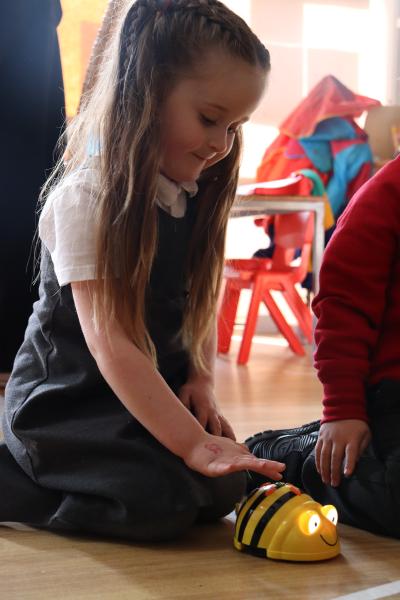
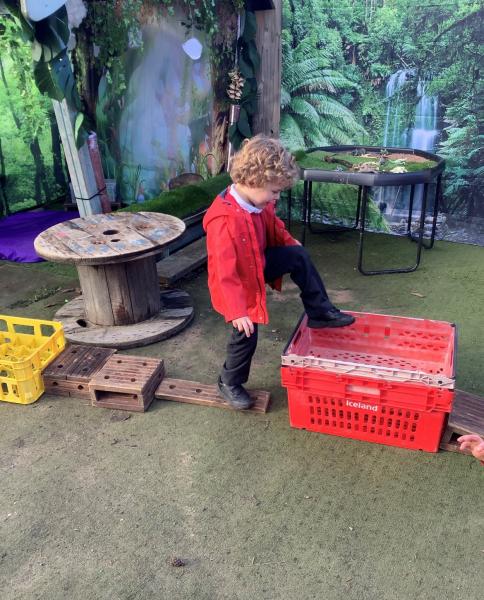
'The teaching of early reading and mathematics is very effective. Children in the early years make a particularly strong start.' (Ofsted 2025)
The EYFS Curriculum at St. Paul’s C.E Primary School
INTENT
At St. Paul's CE Primary School, we provide an environment that is enriched in real life experiences. Our Early Years Educators are inspired by the Reggio Emelia approach where we believe the environment is the third teacher. Our environment inspires children to investigate their interests. Educators encourage children to use language to explore, question and observe an opportunity to learn collaboratively. We believe early years is the foundation for later success which is why we provide a high-quality education where “Horizons are broadened, and dreams are pursued.” (Ofsted 2018) Our children are encouraged to explore, reflect, and strive to live by our embedded Christian values. This allows educators to teach and children to learn in a safe, trusting environment which is rooted in mutual respect.
IMPLEMENTATION
At St. Paul’s C.E Primary we meet the welfare requirements laid down in the Statutory Framework for the Early Years Foundation Stage and actively safeguard and promote the welfare of all our children. Our curriculum is mapped out following the reformed Statutory Early Years Framework 2021 and non- statutory Development Matters guidance.
Our Early Years curriculum allow children to develop knowledge and skill in the seven areas of learning. This includes the three prime areas, Communication and Language Development, Personal, Social and Emotional Development and Physical Development alongside the four core areas, Literacy, Maths, Understanding the World and Expressive Arts and Design.

Early Years curriculum
Title
Version
Description
Size
Hits
Download
docx
Early Years Core Texts and Songs
22.97 KB
356
Download
pdf
Phonics Programme Overview Nursery
133.24 KB
369
Download
Open
pdf
Phonics Programme Overview Reception
577.07 KB
364
Download
Open
docx
Cultural Capital in Early Years
120.43 KB
182
Download
IMPACT
At St. Paul’s our curriculum and its delivery ensure that children develop the characteristics of effective learning of playing and exploring, active learning and creating and thinking critically. These learning behaviours ensure children are confident to take risks, draw on their experiences to improve and discuss their successes and areas for development with resilience and determination to successfully continue their learning in Year 1.
Children make excellent progress from their starting points in the seven areas of development. They have excellent early reading and maths skills which provides a firm foundation to develop their knowledge and skills across the primary curriculum. We aim to ensure all children achieve the good level of development by the end of Reception.
Our overarching principles are:
Unique Child: Every child is unique and has the potential to be resilient, capable, confident and self-assured.
Positive Relationships: Children flourish with warm, strong & positive partnerships between all staff and parents/carers. This promotes independence across the EYFS curriculum. Children and practitioners are NOT alone – embrace each community.
Enabling environments: Children learn and develop well in safe and secure environments where routines are established and where adults respond to their individual needs and passions and help them to build upon their learning over time.
Learning and Development: Children develop and learn at different rates. We must be aware of children who need greater support than others.
In addition, the ‘Characteristics of Effective Learning’ underpin learning and development across all areas and support the child to remain an effective and motivated learner.
Playing and exploring: - Children investigate and experience things, and ‘have a go’. Children who actively participate in their own play develop a larger store of information and experiences to draw on which positively supports their learning.
Active learning: - Children concentrate and keep on trying if they encounter difficulties. They are proud of their own achievements. For children to develop into self-regulating, lifelong learners they are required to take ownership, accept challenges and learn persistence.
Creating and thinking critically: - Children develop their own ideas and make links between these ideas. They think flexibly and rationally, drawing on previous experiences which help them to solve problems and reach conclusions.
Our planning focuses on the children’s needs, their interests, and their stages of development. We seek opportunities to make links between the areas of learning and plan next steps accordingly. We deliver the curriculum through planned, purposeful play as well as adult-directed learning to enable the children to build on what they already know. In class the children may be taught as a whole class, in mixed year groups, in small groups or individuals to ensure that all children are progressing from their own individual starting point. All learning is supported by quality texts which are chosen carefully to encourage children speech, language and communication development.
We have developed a ‘language rich’ environment using stories, nursery rhymes, songs and poems whilst providing time for quality interactions between adults and peers. Our team are trained in delivering high quality interactions that are responsive and enthusiastic. This allows the children to flourish becoming confident, fluent communicators. Children are encouraged to become early readers through enjoyment of books and the systematic teaching of phonics. Our children learn to read as quickly as possible so that they can move from learning to read, to reading to learn, preparing them for the national curriculum in Year 1. Our expectations of progression are aspirational yet achievable. We follow the Little Wandle Phonics program. Children are taught from simple to more complex GPC’s as well as considering the frequency of their occurrence in the most encountered words. All the graphemes taught are practised in words, sentences, and fully decodable books. Children review and revise GPCs and words, daily, weekly and across terms and years, in order to move this knowledge into their long-term memory. As the pupil’s progress within the phases children will move onto written application of sounds, extending into words and sentences. Pupils are then provided with numerous opportunities throughout the day, within the continuous provision to apply their skills in contexts relevant to them. This has been successful in motivating pupils to write and increasing writing opportunities across the curriculum. This program is continued into year 1 supporting continuity.
At St. Paul’s we use a maths mastery approach to learning. Every child is assigned a talk partner where the aim is to develop the children's mathematical knowledge, skills and vocabulary. Children have frequent opportunities to discuss their answers whilst being challenged and encouraged to explain how they got that answer. This allows children to gain a deeper understanding of mathematics as they can articulate the methods they have used and knowledge they have built upon to get their answer. Daily interventions follow the main session for any children identified as not keeping up with the main cohort. The intervention sessions provide an opportunity for staff to explain mathematical concepts securing knowledge that will allow children to move onto the next session the following day. This approach ensures no child is left behind. Alongside this there are a wealth of opportunities to develop and apply mathematics skills in all areas of the Early Years provision.
Our exceptional school environment has been developed to provide the opportunity to learn both indoors and outdoors. Children’s knowledge and skills are developed through a wide range of practical and sensory experiences. The children are supported to learn to work together, manage their feelings and ask questions through skilled adult facilitated play. In early years our environment, routines and interactions are planned for and intentional.
As part of the teaching and learning process, children are assessed in relation to their progress towards Development Matters and the Early Learning Goals. These judgements are made based on accumulative observations and in-depth knowledge of the children acquired through ongoing assessment. These ongoing assessments are used to inform planning, activities and allow practitioners to respond to specific needs.
We build strong partnerships with parents and carers through our open-door policy where staff listen carefully to the development and home experiences of the child. Parents receive regular curriculum information through our app Evidence Me, school website, and social media. A range of parent sessions are delivered throughout the year to help parents support their child’s learning and development both academically and socially. Parents use the Evidence Me app to share home learning and weekly updates as part of our Family Group time. Staff use this platform to provide regular updated to parents on their child’s attainment and progress.
This is a brief synopsis of celebrated days and events in school 2023/ 2024:
|
Autumn Term 1 |
Autumn term 2 |
Spring Term 1 |
Spring Term 2 ) |
Summer Term 1 |
Summer Term 2 |
|
|
Season |
Autumn |
Winter |
Winter/Spring |
Spring |
Summer |
Summer |
|
R.E Celebrated Days |
Harvest – Christianity Sukkot – Judaism |
Christmas - Christianity Diwali – Hinduism |
Chinese New Year Valentine’s Day – Christian value Love Holi Festival |
Easter – Christianity Baisakhi – Sikhism Shrove Tuesday |
Wesak – Buddhism Eid - Islam |
|
|
Events/ Celebrated Days |
Harvest Festival Nursery Rhyme Recital Stay and Play |
Remembrance Day Nativity performance Christmas Fayre Guy Fawkes Night Pantomime visit Breakfast and Book Morning |
Welly Walk – Fundraiser Chinese New Year Valentine’s Day Breakfast and Book Morning |
Shrove Tuesday Tiny Tweeties Easter visit Stand up to Bullying Stay and Play |
Chick hatching Mother’s Day Breakfast and Book Morning |
Father’s Day Summer Fayre Early Years trip Sports Day Stay and Play Reception Worship |